Species tells you almost everything about the job. Paper wasps build the open, upside-down umbrella comb you see under eaves, porch ceilings, deck rails and grill lids — small colonies, low aggression, easy to reach on…
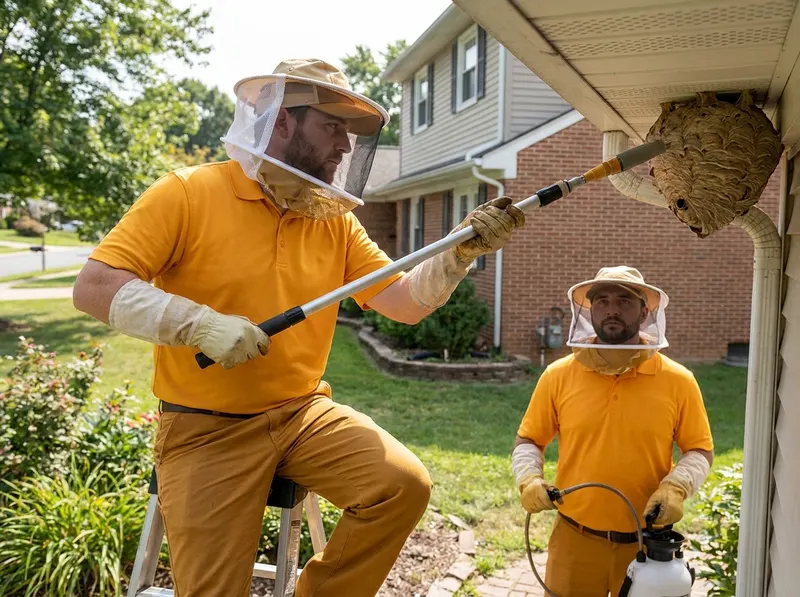
Species tells you almost everything about the job. Paper wasps build the open, upside-down umbrella comb you see under eaves, porch ceilings, deck rails and grill lids — small colonies, low aggression, easy to reach on the split-levels and Cape Cods through Lochearn and Woodmoor. Bald-faced hornets build the enclosed gray football, often in a tree or dense shrub, and they defend it hard for about 20 feet in every direction. Yellowjackets are the late-summer problem in Gwynn Oak: they nest underground in lawns, at tree bases and behind stacked-stone retaining walls, and their colonies peak in size through August and September. European hornets are the ones people call about at night, because they fly after dark and bang against lit windows and porch fixtures.
The decision that matters is knockdown versus removal plus sealing. An aerial hornet nest 30 feet up in a tree along the Gwynns Falls stream valley, well away from any door or walkway, honestly does not need to be touched — the colony dies with the first hard frost and the queens do not reuse the nest the following year. A nest over the back door, above the steps, at a child's playset in Rockdale, or in a ground burrow beside a mower line is a different call, and that one gets treated. The nest that always needs sealing is the one inside the structure — behind an aluminum soffit return in Powhatan or Fairbrook, in a brick weep course, in a soffit vent, or in the rim joist of a rear addition. In those cases treatment comes first and sealing comes after. Plug the hole on a live colony and the workers chew inward, which is how yellowjackets end up dropping through a bedroom ceiling instead of leaving the building.
Attached and semi-detached homes near Gwynn Oak Junction get their own attention. Shared soffits and continuous rooflines mean a colony entering above one unit can occupy a void that runs over the neighbor's ceiling, so we identify which entry the workers are actually using rather than treating the first gap we find. Around older properties near the Gwynn Oak Park grounds, mature trees, wooden sheds and long-standing fence lines produce multiple small nests in one yard, and a single sweep of garage, shed, playset and fence is usually cheaper than three separate visits.
We also tell people what they can handle themselves. A first-year paper wasp comb the size of a quarter, on a shed wall you rarely walk past, is a canned-aerosol job on a cool morning. What store products consistently fail at is a mature ground yellowjacket colony or anything inside a wall — surface spray never reaches the brood, the colony re-routes to a second entrance, and the foraging traffic continues. That is the point where the visit is worth paying for. No monthly plan is required to have a nest removed; wasp and hornet work is priced as a one-time job.
Every job gets a firm, written price after a free on-site visit.
Tell us about your wasp, hornet and yellowjacket nest removal job in Gwynn Oak and we'll send a clear, written quote — usually the same day.
 Pestivora Pest Control