The single most useful thing a homeowner can tell us is where the trail goes. Tiny dark ants marching along a kitchen counter edge toward a sink or dishwasher, giving off a faint coconut-ish smell when crushed, are…
The single most useful thing a homeowner can tell us is where the trail goes. Tiny dark ants marching along a kitchen counter edge toward a sink or dishwasher, giving off a faint coconut-ish smell when crushed, are almost always odorous house ants, and their nests sit in damp, protected spots — under a slab porch, behind exterior trim, inside a wall void near a leaking supply line. Ants pushing small mounds of soil up through a crack in a concrete walkway or driveway seam are pavement ants, common along the older poured walks in Powhatan, Fairbrook, and Gwynn Oak Junction. Larger black ants a half-inch long, especially with a scatter of coarse sawdust-like frass below a windowsill or basement joist, point to carpenter ants nesting in wood that got wet. Carpenter ants do not eat wood; they excavate it, which means the real problem is usually a moisture source that needs finding.
Here is the honest do-this-first advice. A single thin trail in one room, showing up for a few days, is often solved with a gel or liquid sugar bait placed beside the trail and left alone — and the mistake most people make is spraying the trail first, which scatters the foragers and stops them carrying bait back to the nest. If the trail is gone in a week and stays gone, you saved yourself a service call. Call us when the trail returns within two weeks, when trails appear in more than one room or on more than one floor, when you find frass or hollow-sounding wood, or when ants are coming out of an electrical outlet or light fixture — those all mean the nest is inside the structure and surface products won't reach it.
Attached homes change the plan. In the duplexes and semi-detached blocks around Gwynn Oak Junction, Woodmoor, and Lochearn, a nest in a shared wall or under a shared front stoop feeds both sides, so treating one kitchen and stopping there just moves the foraging. We treat the connected structure as one job, work the shared party wall and the common slab edge, and tell you plainly if the neighbor's unit needs a look for the work to hold. On the wooded lots in Hernwood Heights and the older tree canopy near the Gwynn Oak Park grounds, mature oaks and dead limbs are legitimate carpenter ant habitat, and the fix leans on trimming contact branches, correcting grade and downspout runoff, and sealing the sill plate — not on a heavier spray.
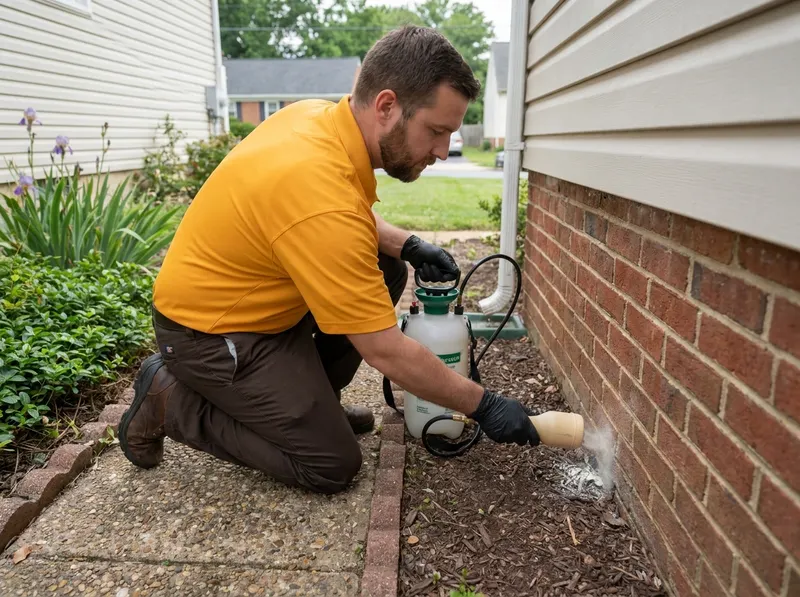
Exterior-only treatment is the right call when ants are trailing in from outside and no nest is inside the walls; a full interior and exterior job is warranted when trails persist in winter or you find frass, both of which indicate an indoor nest. The trade-off is straightforward: exterior-only costs less and disrupts your house less, but if an indoor nest exists it will keep producing foragers. That is why the visit starts with identification and a walk of the perimeter, downspouts, and slab line before any product comes off the truck. Split-levels and slab-on-grade homes in Milford Mill and Rockdale get particular attention at the sliding-door track and the garage-to-house threshold, which are the two gaps we find open most often in that housing stock.
Every job gets a firm, written price after a free on-site visit.
Tell us about your ant control job in Gwynn Oak and we'll send a clear, written quote — usually the same day.
 Pestivora Pest Control