Pestivora Pest ControlPestivora Pest Control

Overwintering Pest Control

Overwintering insects are not a hygiene problem, which is why kitchen sprays and store-bought foggers disappoint people every November. Stink bugs and boxelder bugs spend the summer on trees and weeds, then on the…
Call (227) 269-6623 →(227) 269-6623
Overwintering Pest Control in Gwynn Oak, MD
Quick answer
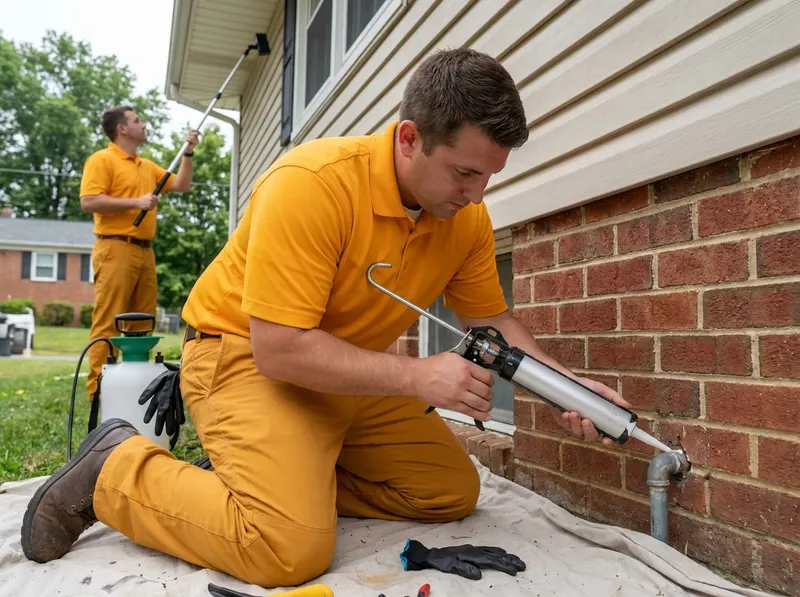
  • Included: full exterior inspection, a residual perimeter and upper-wall treatment on sun-facing walls, soffit and window-frame bands, attic vent and weep-hole checks, plus a written list of the gaps letting insects in.
  • Timing: most Gwynn Oak homes are treated between mid-September and late October, before the first hard cold snap pushes insects to the warm side of the siding. One visit typically takes 45–90 minutes.
  • Cost: ballpark $250 to $500 for a treatment-only visit on a typical single-family home; $450 to $900 when sealing and vent screening are added. $250 is our minimum charge.
  • Pests covered: brown marmorated stink bugs, boxelder bugs, cluster flies, Asian lady beetles, western conifer seed bugs, and ground beetles that follow them in.
  • Booking: call (227) 269-6623. The on-site visit and the quote are free, the price is confirmed before any work starts, and no monthly plan is required for a seasonal treatment.

Overwintering insects are not a hygiene problem, which is why kitchen sprays and store-bought foggers disappoint people every November. Stink bugs and boxelder bugs spend the summer on trees and weeds, then on the first cool, bright afternoon they fly toward the warmest vertical surface they can find and crawl into whatever crack is available — the gap behind a shutter, the seam where aluminum siding meets a window, an unscreened gable vent, a torn attic soffit panel. Once they are in the wall void they are effectively out of reach until they wake up on a warm February day and appear on the inside of the storm window. The only treatment that reliably reduces next winter's indoor count is applied outside, in the fall, before they enter.

Gwynn Oak makes this a predictable annual event. The Gwynns Falls stream valley and the tree line running toward Gwynns Falls Leakin Park carry heavy maple, ash and boxelder growth, and boxelder bugs breed on those seed-bearing trees all summer within easy flight of Woodmoor and the Gwynn Oak Park area on the old amusement park grounds. Houses with west and south exposure take the worst of it — the hillside lots in Hernwood Heights and Powhatan hold afternoon heat in brick and aluminum siding long after the air cools, and that warm wall is exactly the beacon these insects use. In Fairbrook and Rockdale we see more cluster flies, which prefer older attics with gable louvers and unsealed chimney chases, and their larvae develop in earthworms in the soil, so a well-watered lawn and a dark attic is all they need. Around Gwynn Oak Junction and Milford Mill, the attached brick duplexes complicate things: an untreated neighbor's wall becomes a reservoir, so we treat the shared elevation and the roofline seam rather than stopping politely at the property line.

When does a treatment-only visit fit, and when should you pay for exclusion? If your house had a handful of stink bugs on the ceiling last winter and the siding, vents and window seals are in reasonable shape, a fall perimeter and upper-wall application is the sensible spend. If you were vacuuming up dozens at a time, hearing them tap around the light fixtures, or finding cluster flies massed on an upstairs windowsill in January, the insects are already wintering inside a wall or attic void and a spray alone will underperform. That is when the sealing work earns its cost — screening gable and ridge vents, closing the gap above door frames, sealing behind shutters, tightening the soffit-to-fascia joint. Exclusion costs more once, then keeps paying; a spray is cheaper and needs repeating every fall. Sealed out beats sprayed down, and we will tell you plainly which one your house needs.

One honest note, because we would rather you trust us than book blind: if you are seeing five or six stink bugs a winter, a good shop vacuum and a tube of exterior caulk around the two worst windows may genuinely be enough, and we will say so on-site. The jobs worth our visit are the ones with volume, an attic involved, an attached neighbor, or gaps you cannot safely reach. Nothing is treated inside an occupied bedroom for overwintering insects, no fogging, no contract signature required to get a number from us.

What it costs

Fall perimeter + upper-wall treatment, single-story home$250 – $375
Fall treatment, two-story or larger home (eaves and soffit bands included)$325 – $500
Treatment plus targeted exclusion (vent screening, gap and shutter sealing)$450 – $900
Attached duplex / rowhome — coordinated treatment of shared elevation$500 – $800
Cluster fly attic and gable-vent work, added to a scheduled treatment$250–$300
Late-winter or spring emergence visit (insects already indoors)$250 – $350

Every job gets a firm, written price after a free on-site visit.

Common questions

When is the best time to schedule overwintering pest control in Gwynn Oak?
Mid-September through late October is the window for Gwynn Oak homes. Stink bugs and boxelder bugs start moving toward warm walls on the first cool, sunny afternoons of fall, so a treatment applied before that flight is far more effective than one applied in December after they are already inside the wall voids.
Why does my Gwynn Oak house get stink bugs when my neighbor's doesn't?
Sun exposure and gaps decide it. In Gwynn Oak, west- and south-facing walls — common on the hillside lots in Hernwood Heights and Powhatan — hold heat longer and attract far more landing insects, and a house with unscreened gable vents, loose shutters or open siding seams gives them somewhere to go. A neighbor with a shaded elevation and tight trim can sit through the same swarm untouched.
Will one fall treatment stop stink bugs in Gwynn Oak for good?
One fall treatment reduces the number that get in; it does not permanently end the pressure. Gwynn Oak sits next to the Gwynns Falls stream valley and its heavy maple and boxelder canopy, so new insects arrive every autumn. Homes that stay quiet long-term are the ones where vents were screened and gaps sealed, which is why exclusion is part of the quote wherever we find entry points.
What does overwintering pest control cost in Gwynn Oak, and is there a minimum?
Expect a ballpark of $250 to $500 for a treatment-only fall visit on a typical Gwynn Oak single-family home, and $450 to $900 when exclusion and vent screening are included. Our minimum charge is $250. Every figure is a range until we walk the exterior — the exact price is confirmed on-site, in writing, before anything is applied.
I live in an attached duplex near Gwynn Oak Junction — will treatment work if my neighbor doesn't treat?
It still helps, and we adjust the approach. In the attached brick duplexes around Gwynn Oak Junction and Milford Mill, insects overwinter in shared wall and attic space, so we treat and seal the full shared elevation, the roofline seam and any common soffit rather than stopping at the party wall. Results are strongest when both units are done, and we are glad to speak with the neighbor or landlord and schedule the pair together.
Do cluster flies on my upstairs windows in Gwynn Oak mean the same treatment?
Cluster flies need attic-focused work, not just a perimeter spray. Gwynn Oak's older Cape Cods and split-levels in Fairbrook and Rockdale often have louvered gable vents and open chimney chases where cluster flies gather by the hundreds, then drift to sunny upstairs windows in winter. Screening those openings and treating the attic entry points is what reduces them; a ground-level perimeter application alone will not.

Ready to get started?

Tell us about your overwintering pest control job in Gwynn Oak and we'll send a clear, written quote — usually the same day.