The housing stock here is the reason termites keep showing up. Much of Gwynn Oak Junction, Powhatan, and Lochearn was built out in the 1940s and 1950s — Cape Cods and brick semi-detached homes on block foundations,…
The housing stock here is the reason termites keep showing up. Much of Gwynn Oak Junction, Powhatan, and Lochearn was built out in the 1940s and 1950s — Cape Cods and brick semi-detached homes on block foundations, many with additions poured as slabs later on. Every one of those slab-to-foundation seams is a path from soil to framing that termites can use without ever crossing open air. Add the Gwynns Falls stream valley cutting through the west side of the neighborhood, mature oaks holding moisture in the yards, and decades of mulch piled against foundation walls, and you get consistently damp soil right where the wood starts. That is the whole invitation. Termites need soil contact and moisture, so the fix is as much about grade, gutters, and wood contact as it is about chemistry.
Most calls arrive in one of two forms. The first is spring swarming — warm afternoons after rain in March, April, and May, when winged reproductives pour out and die on windowsills and in light fixtures. Count the wings: termite swarmers have four wings of equal length, a thick straight waist, and straight beaded antennae, while flying ants have a pinched waist and a longer front wing pair. Finding swarmers indoors means a colony is already inside the structure, not just in the yard. The second form is discovery during a project or a sale — a homeowner in Hernwood Heights pulls up subfloor, or a buyer near Milford Mill needs the wood-destroying insect report for closing. Both start the same way: inspect, document, then decide on treatment scope.
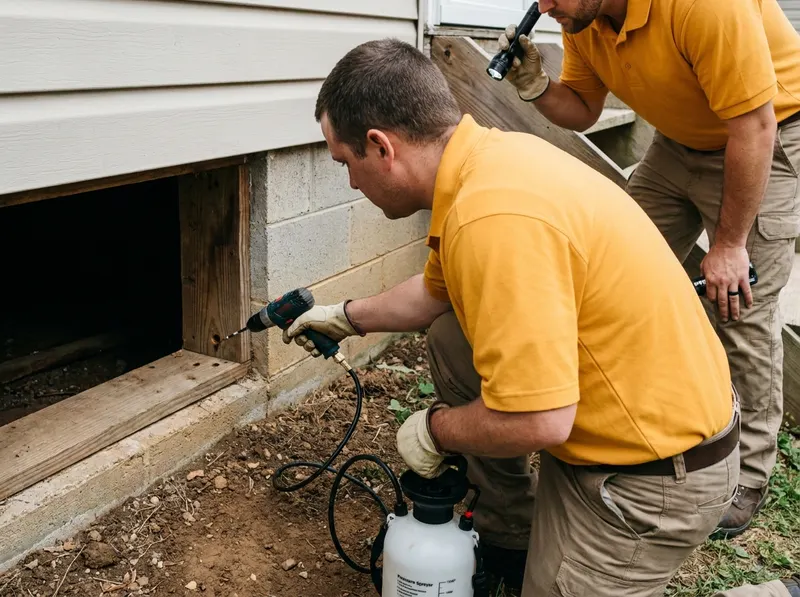
On the treatment choice, the trade-off is straightforward. A liquid termiticide barrier means trenching and treating the soil around the perimeter and drilling through slab seams and porch pads where needed; it acts fast on an active infestation and is the usual answer when tubes are already running up a foundation wall. In-ground bait stations are less invasive — no trenching through a finished patio or a landscaped bed — and they eliminate the colony over months rather than weeks, with monitoring that keeps working after the first year. Homes with wraparound concrete, flagstone walks, or heavy plantings near the Gwynn Oak Park grounds often make more sense on bait; homes with open soil perimeters and clear access usually get better value from liquid. A localized spot treatment only makes sense when activity is confined to one clearly bounded area, such as a single deck post or one garage sill.
If your home is a semi-detached or duplex — common through Woodmoor, Fairbrook, and Rockdale — the party wall matters. A subterranean colony feeding on your side of the foundation does not recognize the property line, and treating only half of a shared footing leaves an untreated approach. We will say plainly when a neighbor needs to be part of the plan instead of selling you a barrier with a hole in it.
Before you spend anything, there are two things worth doing yourself: pull mulch and soil back so at least six inches of foundation is visible, and extend downspouts so water discharges well away from the wall. Move firewood off the foundation while you are out there. Those steps will not clear an active colony — retail stakes and foam reach the workers you can see, not the queen — but they remove the conditions that brought the colony in, and they make any treatment last longer. That is the difference we care about: sealed out, not just sprayed down.
Every job gets a firm, written price after a free on-site visit.
Tell us about your termite inspection and treatment job in Gwynn Oak and we'll send a clear, written quote — usually the same day.
 Pestivora Pest Control