The single most useful thing a homeowner can do here is find out whether tree-of-heaven (Ailanthus altissima) is growing on or beside the property. Spotted lanternfly strongly favors it, and tree-of-heaven colonizes…
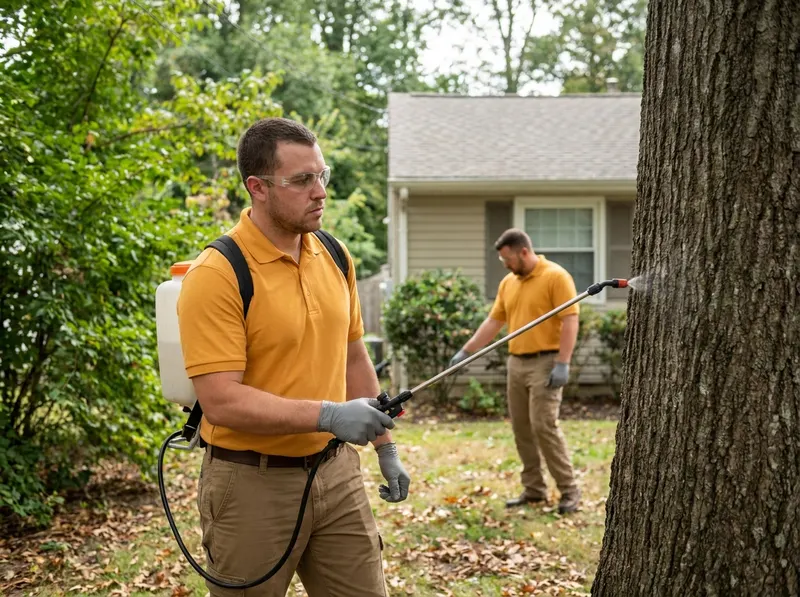
The single most useful thing a homeowner can do here is find out whether tree-of-heaven (Ailanthus altissima) is growing on or beside the property. Spotted lanternfly strongly favors it, and tree-of-heaven colonizes exactly the ground Gwynn Oak has plenty of — the disturbed slopes and stream banks along the Gwynns Falls valley, fence lines and alley edges around Gwynn Oak Junction, the wooded margins of the old amusement park grounds at Gwynn Oak Park, and the untended strips behind commercial lots near Security Square Mall. Properties in Powhatan, Fairbrook, and Lochearn that back onto that kind of unmanaged edge tend to get the heaviest adult pressure in late summer. If the source tree is on your side of the line, removing or treating it changes the whole season. If it is on the neighbor's side or in a county right-of-way, we plan around it instead — trap trees, circle traps, and protection for the ornamentals you care about.
Deciding between egg season and adult season matters more than the product used. Scraping egg masses between roughly October and April is slow, unglamorous, and the highest-value work available, because one gray, mud-smeared mass on a trunk, a downspout, a grill cover, or the underside of a deck rail holds dozens of eggs. Adult-season treatment in July through November is more visible — you see the insects drop — but it is suppression, not elimination, because winged adults keep arriving from Gwynns Falls Leakin Park and the tree lines around the Woodlawn campuses. Homeowners who want fewer lanternflies next year book the winter scrape. Homeowners who want the deck usable in September book adult knockdown. Doing both is what actually reduces numbers on a lot in Hernwood Heights or Woodmoor over two seasons.
What we will tell you plainly: spotted lanternfly does not damage a house. It does not chew wood, it does not nest in walls, and it will not infest your pantry. The real nuisance is honeydew — sugary waste that rains down under a fed-on tree, blackens with sooty mold on pavers, siding, and cars, and pulls in wasps and yellow jackets. That is often the reason a Milford Mill or Rockdale caller reaches for the phone in August: the wasps, not the lanternflies. If your issue is a wasp nest over the back door, that is a different visit and a different price, and we will say so rather than sell you tree work you do not need.
Skip the sticky bands sold at hardware stores. Wide adhesive bands wrapped around a trunk catch songbirds, squirrels, and bats along with nymphs, and they are a common regret. Screened circle traps funnel nymphs into a collection container without the bycatch, and we install them where trunk shape cooperates. Store-bought spray does knock down the adults it directly hits and nothing more — no residual, no effect on eggs, and no effect on the host tree that is drawing them in. Handling a few insects on a porch railing yourself is completely reasonable. Bring us in when you are counting them by the dozen on one trunk, when honeydew is staining a driveway, or when you suspect tree-of-heaven on the property. Maryland Department of Agriculture maintains current spotted lanternfly quarantine and reporting guidance for Baltimore County; we will point you to it during the visit, and we ask that you avoid moving firewood, nursery stock, or yard debris off the property until the eggs are dealt with. Sealed out, not just sprayed down — for this pest that means killing the eggs and cutting off the host, not fogging the yard and hoping.
Every job gets a firm, written price after a free on-site visit.
Tell us about your spotted lanternfly treatment job in Gwynn Oak and we'll send a clear, written quote — usually the same day.
 Pestivora Pest Control