The gaps matter more than the poison. A house mouse gets through an opening around a quarter inch — roughly the width of a pencil — and a Norway rat needs about half an inch. On the older bungalows and duplexes around…
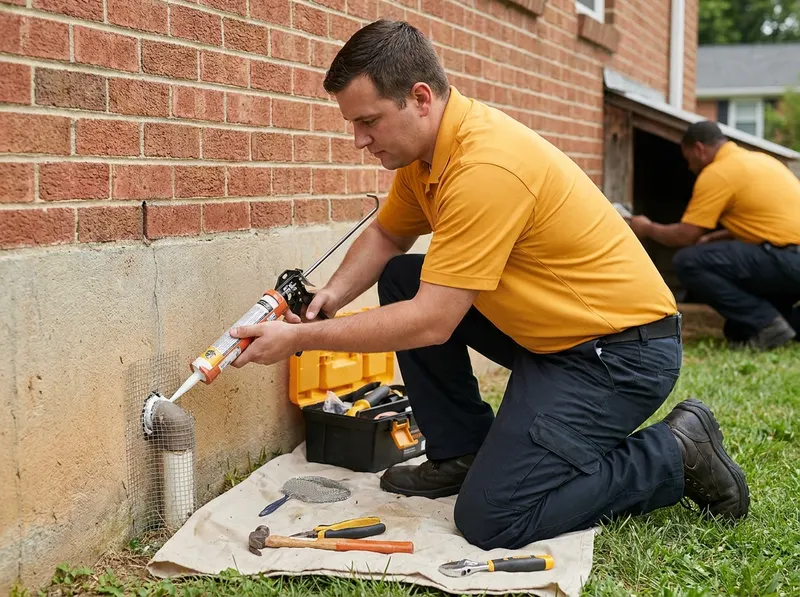
The gaps matter more than the poison. A house mouse gets through an opening around a quarter inch — roughly the width of a pencil — and a Norway rat needs about half an inch. On the older bungalows and duplexes around Gwynn Oak Junction and Powhatan, that quarter inch shows up in predictable places: mortar joints crumbling out of rubble and fieldstone foundation walls, the sill plate above the foundation, gaps where the gas line and water service punch through, and unscreened crawlspace vents. On the 1950s and 60s ramblers through Lochearn, Woodmoor, Milford Mill, and Rockdale, the usual culprits are the attached-garage door corners, a chewed rubber sweep, the dryer vent flap that no longer closes, and the soffit-to-fascia seam where a mature limb near the Gwynn Oak Park grounds gives roof access. We photograph what we find and show you, because you should be able to see the hole you're paying to close.
Rats and mice are different problems in this part of Baltimore County. Norway rats travel low and along water and cover — the Gwynns Falls stream valley, storm drain runs, alley lines just across the Baltimore City line, and any yard with dense ivy, woodpiles, or an unsecured can. Rat work means burrow inspection at the foundation, exterior trapping in secured locations, and heavier-gauge sealing, since a rat will pull loose foam or steel wool straight back out. House mice are the October and November call: the first real cold snap in Fairbrook or Hernwood Heights sends them from the field edges into basements and kitchen cabinets, and one female can produce several litters a year, so a two-mouse sighting in November is not a two-mouse problem in January.
When trapping alone is the right call: a single mouse that walked in an open door, a garage with one obvious gap you've already closed, or a rental turnover where you need the unit cleared fast and the landlord is handling repairs separately. When you need full exclusion: any infestation that came back after a previous treatment, any attached home, and any basement with active runways along the joists. In the duplexes and semi-detached blocks common through Gwynn Oak, mice move through shared party walls, plumbing chases, and the joist bays between units — treating your half and ignoring the connection is exactly why the problem returns. The trade-off is honest: exclusion costs more up front than a bait placement, and it takes longer, because someone has to get on hands and knees at the sill plate and up at the soffit line. What you buy is a house that stays closed.
On bait: we use it selectively and we tell you where. Interior baiting can leave a rodent dead inside a wall cavity, so in occupied homes with kids or pets our default is trapping inside and sealing outside. If you've already run store-bought snap traps at the stove and along the basement wall and you're still finding fresh droppings, the population has an entry route you haven't found — that's the point at which a paid inspection saves money instead of spending it. Sealed out, not just sprayed down is the whole method here.
Every job gets a firm, written price after a free on-site visit.
Tell us about your rodent control and exclusion job in Gwynn Oak and we'll send a clear, written quote — usually the same day.
 Pestivora Pest Control